


Viettel "Make-in-Vietnam" Cloud Computing to gain market share at home
Oct 14, 2022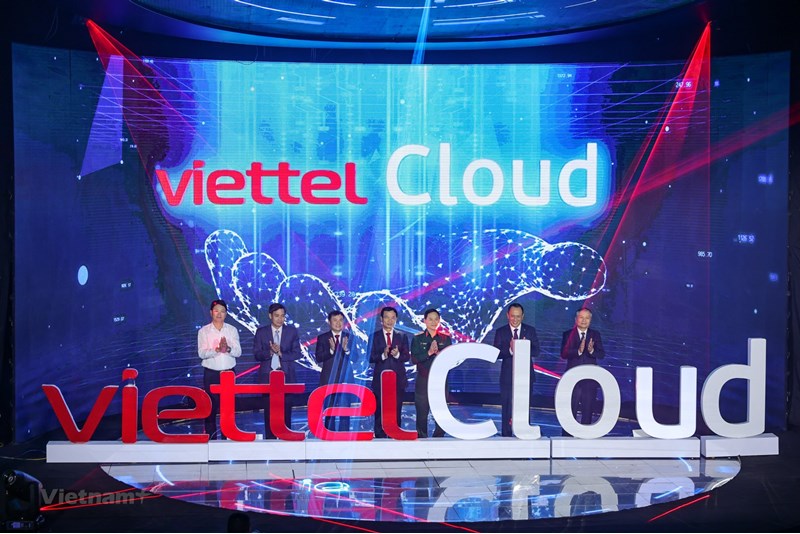
In the digital economy development strategy, Vietnam sets a target to have 100 percent of government agencies using cloud computing by 2025, and 70 percent of Vietnam’s businesses using cloud computing services provided by Vietnamese firms.
Currently, Vietnamese enterprises account for only 20% of the cloud computing market share while 80% belongs to foreign companies. Viettel Cloud can address the issue through comprehensive suite of cloud computing services with tightening cybersecurity.
Viettel Cloud has the largest data center infrastructure in Vietnam with 13 data centers, 9.000 racks and 60.000 m2 gross floor area. In 2025, Viettel Cloud will be invested over 400.000 USD to expand the scale to 17.000 racks. Following the roadmap, in 2030, the total investment can reach 1.6 mil USD with 34.000 racks, meeting international standard.
Viettel Cloud proudly presents the ultra-wideband connection with the largest fiber optic backbone cable systems in Indochina, 5 international undersea cable routes and 500,000km of fiber optic cable covering 63 provinces.
Viettel Cloud offers most trusted end-to-end security meeting security requirements for E-commerce, and is the only company in Vietnam accredited by SOC 1,2,3 Certification of American Institute of CPAs.
Viettel Cloud applies cutting-edge technology with open-source codes such as OpenStack, Kubernetes, Ceph, Prometheus, Grafana, committing to the highest stability. Viettel engineers also directly build, own and deploy these open source codes.
Viettel Cloud unleashes an avalanche of offerings, with a total of more than 70 products and services ranging from server hosting, to AI platform and IoT platform.
This ecosystem includes 5 groups: Cloud Infrastructure, Cloud Platform, Cloud Software, Consulting, Deployment & Operation, Cloud Colocation.
Looking ahead, Viettel Cloud will continue to enable industries through Infrastructure as a Service, Technology as a Service, and Expertise as a Service, to unleash digital with Everything as a Service and make cloud services acessible to everyone, build the cloud foundation for an intelligent world.
At the ceremony, Tao Duc Thang - Chairman and General Director of Viettel Group affirmed: "Viettel commits that every citizen, household, organization and enterprise will have a data warehouse on Viettel's cloud computing platform. Viettel is committed to universalizing cloud computing like the way we have universalized telecommunication services, bringing mobile phones to all Vietnamese.”
Delivering speech at the event, Minister of Information and Communication, Nguyen Manh Hung, affirmed “The Ministry of Information and Communications (MIC) acknowledges Viettel's efforts in the “Make-in-Vietnam strategy” and highly appreciates Viettel Cloud's infrastructure. Viettel has accompanied the Government and the MIC in several digital solutions such as the National Immunization Information System, the PC-Covid application, the surveillance cameras for medical facilities, etc., contributing to Vietnam’s successful battle against the pandemic. Viettel Cloud is not only about providing specific solutions but also fueling cloud adoption and digital transformation aspriration in Vietnam.”
Featured news
Related news
Viettel IDC: The Only VMware Sovereign Cloud Provider in Southeast Asia
At VMware Explore 2026 in Las Vegas, Broadcom introduced a group of 57 sovereign cloud service providers built on VMware Cloud Foundation. Viettel IDC was the only provider from Southeast Asia included in the list, marking another significant step forward for a Vietnamese enterprise in the regional cloud infrastructure market.
Kubernetes vs Serverless? Which Is the Right Choice for Enterprise Architecture?
In the Cloud Native era, Kubernetes vs Serverless represents a classic clash between two philosophies: Maximum control or ultimate convenience? If Kubernetes can be considered the solid backbone for complex Microservices systems, Serverless is the speed-driven launchpad that helps optimize costs for enterprises. So, which one is the right fit for your architecture?
What Is Kubespray? A Production-Ready Kubernetes Deployment Solution for Enterprises
Kubernetes has revolutionized Container orchestration, providing an efficient and flexible solution for application deployment. However, manually setting up and maintaining a Kubernetes Cluster is often highly complex and can easily become overwhelming.
What Is Minikube? A Beginner’s Guide to Running Kubernetes
Do you want to start learning Kubernetes but are concerned about server rental costs or complicated configuration? Minikube is the perfect answer. So, what is Minikube, and how does this tool turn your laptop into a “pocket-sized” Kubernetes Cluster that you can use for completely free hands-on practice?
What Is a Helm Chart? The Most Effective Way to Manage Kubernetes Applications
Are you overwhelmed by having to manage dozens of separate YAML configuration files every time you deploy an application to Kubernetes? That’s when you need Helm Chart – a solution often described as the key to escaping configuration hell.
What Is a Service in Kubernetes? A Complete A-Z Guide to Service Types and Configuration
In the Kubernetes world, Pods have one defining characteristic: they are ephemeral. They are constantly created, terminated, and replaced. Each time this happens, a Pod’s IP address changes. This creates a challenging problem: How can A communicate with B if B’s IP address keeps changing? The answer is Kubernetes Service.
What Is a Namespace in Kubernetes? A Complete A-Z Guide to Creating and Managing Namespaces
A Kubernetes Cluster is like a huge office building. Without proper zoning, resource conflicts between departments (Dev, Test, Prod) are inevitable. Kubernetes Namespaces are the essential partitions that divide physical infrastructure into multiple Virtual Clusters, ensuring effective isolation and management.
Kubernetes Cost Optimization: Effective Cloud Cost Reduction Strategies for Businesses
Kubernetes enables businesses to deploy and operate containerized applications at scale with greater flexibility. However, this flexibility also comes with increasingly complex cost management challenges. Kubernetes cost optimization is not simply about cutting resources or shrinking the cluster.
What Is the Vertical Pod Autoscaler? Effectively Optimizing Pod Resources in Kubernetes
In Kubernetes, manually setting CPU and memory resources for Pods can easily lead to either resource shortages or infrastructure waste. Improper configuration can cause applications to slow down, experience OOMKilled errors, or prevent the cluster from fully utilizing its available capacity. The Vertical Pod Autoscaler provides a smarter approach by automatically recommending and adjusting resources based on actual usage.
What Is the Kubernetes Scheduler? How Kubernetes Decides Where Pods Run
In Kubernetes, a Pod does not automatically start running immediately after it is created. It first needs to be assigned to a suitable node within the cluster. This task is handled by the Kubernetes Scheduler, whose role is to determine where a Pod should run. The Scheduler helps allocate resources efficiently, maintain system stability, and optimize overall performance.
Comment ()