


Do You Need DevOps to Operate a Cloud Server? Insights from Real-World Implementations
Oct 27, 2026In recent years, Cloud Server has become a popular infrastructure platform for almost every type of IT system, ranging from small business websites to large-scale applications. However, alongside the flexibility and scalability of cloud computing comes increasing operational complexity. Many organizations are asking: Do you need DevOps to operate a Cloud Server, or is a traditional IT team sufficient?
In this article, Viettel IDC examines the question from a practical implementation perspective, helping you understand when DevOps is optional and when it becomes a critical factor.
What Is a Cloud Server?
A Cloud Server is a virtual server deployed on cloud computing infrastructure. It allows users to provision, configure, scale up, or scale down resources flexibly through a management platform. Unlike a traditional physical server, a Cloud Server is not tied to fixed hardware but operates using resources dynamically allocated from the cloud infrastructure.
The main advantages of Cloud Servers are rapid scalability, fast deployment, and cost optimization based on actual usage. However, this flexibility also makes operations more complex than managing a single physical server. As the number of servers, services, and environments grows, the risks of configuration errors, downtime, and poorly controlled changes increase accordingly.
What Is DevOps?
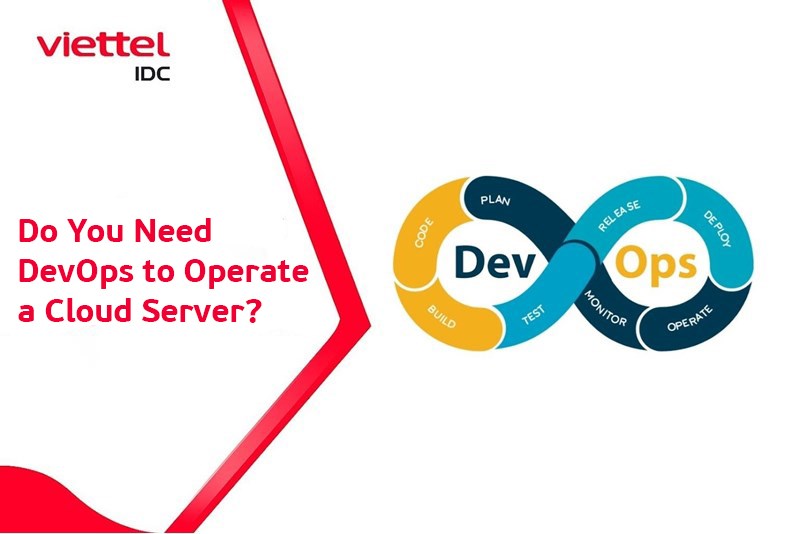
DevOps is not simply a job title or a collection of tools. It is an operational approach that brings together software development (Development) and system operations (Operations). The primary goals of DevOps are to shorten software delivery cycles, improve system stability, and reduce friction between technical teams.
In a cloud environment, DevOps connects code, infrastructure, and operations. Rather than relying on manual deployment, DevOps promotes automation, standardization, and continuous monitoring, helping cloud systems operate more efficiently and sustainably.
Do You Need DevOps to Operate a Cloud Server?
When DevOps Is Not Necessarily Required
For small systems, such as corporate websites, landing pages, or simple internal applications, a Cloud Server is often used much like a traditional VPS. In these cases, updates are infrequent, the number of servers is limited, and downtime has little impact on business operations. Manual management may therefore be perfectly acceptable.
In addition, if the technical team is experienced, the system changes infrequently, and there is no need for flexible scaling, DevOps does not have to be an immediate priority from the outset.
When DevOps Is Recommended for Cloud Server Operations
When a system begins to scale, involves multiple environments (development, staging, and production), requires frequent updates, or serves live users, DevOps becomes almost indispensable. This is particularly true for microservices architectures, SaaS applications, and e-commerce platforms, where manual deployment and operations quickly reveal their limitations.
At this stage, DevOps not only helps reduce human error but also ensures consistency, scalability, and stability across the Cloud Server environment.
The Role of DevOps in Cloud Server Operations
Deployment Automation (CI/CD)
CI/CD is one of the most important pillars of DevOps. Instead of deploying each release manually, CI/CD pipelines automate the process of building, testing, and deploying applications to Cloud Servers. This reduces configuration errors, accelerates release cycles, and makes it easier to roll back changes when problems occur.
In cloud environments, where resources can change continuously, CI/CD helps ensure that every deployment is repeatable and controlled.
Infrastructure as Code (IaC)
Infrastructure as Code (IaC) allows teams to define their entire Cloud Server infrastructure in code rather than configuring it manually through a management interface. As a result, creating, modifying, or decommissioning servers becomes faster, version-controlled, and easier to audit.
IaC is particularly important as cloud environments grow. It helps prevent configuration inconsistencies between servers and reduces the risk of environment drift.
Monitoring, Logging, and Proactive Alerting
DevOps focuses not only on deployment but also on long-term operations. Monitoring, logging, and alerting systems help detect performance, resource utilization, and security issues before users are affected.
For Cloud Servers, where resources are often billed according to usage, effective monitoring also helps optimize costs and prevent unnecessary spending.
Comparing Cloud Server Operations With and Without DevOps
When Does a Business Need DevOps for Cloud Servers?
Businesses do not have to wait until their systems become overloaded before considering DevOps. In practice, DevOps should be considered as soon as Cloud Servers begin to play a significant role in business operations, particularly for systems directly related to revenue, customers, or critical data.
Common signs that a business may be ready to adopt DevOps include:
- Application deployments are becoming more frequent, but each update still requires manual work and is prone to errors.
- Even brief periods of downtime have a noticeable impact on the user experience.
- The technical team is constantly dealing with recurring incidents but has little time to improve the system.
Furthermore, if a business is expanding rapidly by adding users, services, or staging and production environments, continuing to operate its cloud infrastructure using traditional methods can cause staffing costs, error risks, and incident recovery times to grow dramatically.
Adopting DevOps early helps businesses manage complexity from the outset rather than constantly firefighting after the system has become difficult to control.
A Roadmap for Adopting DevOps for Cloud Server Environments
Phase 1 – Standardize Cloud Operations
This is the most important foundation to establish before introducing automation. During this phase, businesses focus on standardizing their entire Cloud Server environment, including server provisioning, network architecture, access permissions, deployment procedures, and configuration conventions.
The goal is to eliminate ad hoc practices based on individual habits and reduce dependence on a small number of key engineers.
Cloud resources should be managed centrally, documented clearly, and protected by strict access controls. Once the environment is standardized, onboarding new employees, scaling the system, and transferring operational responsibilities become much easier.
Phase 2 – Introduce Automation Incrementally
After standardization, businesses can begin automating repetitive tasks that are prone to manual errors. Instead of deploying applications manually, CI/CD pipelines are established to automate building, testing, and deployment.
Tasks such as data backup, resource scaling, and performance monitoring can also be integrated with appropriate automation tools.
Phase 3 – Implement Full DevOps and Continuous Optimization
Once automation becomes standard practice, DevOps evolves from a collection of tools into an operational culture. Development and operations teams work closely together and share responsibility for system quality, from writing code to running applications on Cloud Servers.
At this stage, systems are continuously monitored through logging, monitoring, and proactive alerting. Performance, reliability, and cloud cost metrics are regularly analyzed to identify opportunities for optimization.
Improvements are implemented in short cycles, helping Cloud Server environments remain available, flexible, and aligned with constantly changing business needs.
Conclusion
DevOps is not always mandatory for operating a Cloud Server. However, for systems designed to grow and evolve over the long term, DevOps is almost inevitable. Adopting DevOps at the right time helps businesses maximize the benefits of cloud computing, reduce operational risks, and establish a solid foundation for growth.
If your business wants to deploy Cloud Servers quickly and reliably, explore Viettel IDC's Viettel Cloud Server service. This virtual server solution offers rapid provisioning, high performance, strong security, high availability, and cost efficiency for businesses.
Learn more at: https://viettelidc.com.vn/en/cloud-server
For consultation and more information about Viettel IDC's services, please contact the company through the following channels:
- Hotline: 1800 8088 (toll-free)
- Fanpage: https://www.facebook.com/viettelidc
- Website: https://viettelidc.com.vn
Related news
When Should You Scale Up vs. Scale Out? A Guide to Choosing the Most Effective Approach
As IT systems evolve, particularly websites, web applications, and digital service platforms, scaling resources becomes almost inevitable. However, deciding how to scale is a challenge that leaves many businesses and technical teams uncertain.
Can You Recover Data That Has Been Accidentally Deleted from the Cloud?
Can you recover data that has been accidentally deleted from the cloud? This is a common question among users today. Cloud storage services such as Dropbox, Google Drive, and Microsoft OneDrive all incorporate data protection mechanisms that temporarily retain deleted files for a certain period.
How Do Cloud Providers Protect User Data?
In the era of digital transformation, how cloud providers protect user data has become a major concern for both businesses and individuals. As more data is stored on cloud computing platforms, cloud providers must implement multiple layers of sophisticated security measures to ensure that data remains safe from cyberattacks, data breaches, and infrastructure failures.
Can You Run a Game Server on a Cloud Server? A Detailed Explanation
A Cloud Server is more than just a data storage solution. It can also be used to run games directly, host game servers, or support Cloud Gaming. Viettel IDC will help you understand the capabilities of Cloud Servers in the gaming industry and how to choose the right server configuration for your needs.
Is Cloud Server Suitable for Hosting a WordPress Website? A Detailed Explanation
WordPress is a popular website-building platform, but running a website reliably requires sufficiently powerful and flexible server infrastructure. This is why many businesses ask whether Cloud Server is suitable for hosting a WordPress website when choosing a hosting environment.
How to Improve Cloud Server Performance: Best Optimization Tips
How to improve Cloud Server performance is a common question among businesses running websites or applications on cloud computing platforms. If a server runs slowly or processes data inefficiently, the system may experience performance issues that affect speed and user experience.
What Is the Difference Between Cloud Storage and Cloud Server? A Detailed Comparison
What is the difference between Cloud Storage and Cloud Server? This is a common question among businesses starting to use cloud computing services. Although both are part of the cloud ecosystem, Cloud Storage and Cloud Server serve different purposes and functions in data storage and IT system operations.
What Is an Image Server? How It Works and Its Role in Website Infrastructure
An image server is a server specifically designed to store, process, and deliver images for websites or applications. By using dedicated image processing and delivery mechanisms, an image server helps improve page load speeds, reduce the workload on the main server, and enhance the user experience when accessing a system.
Can Data Be Exposed When Using a Cloud Server? A Detailed Explanation
Can data be exposed when using a Cloud Server? In practice, data can still be exposed if the system is misconfigured or has weak security. However, these risks can be effectively managed by choosing a reputable cloud service provider and implementing appropriate security measures.
Comment ()